
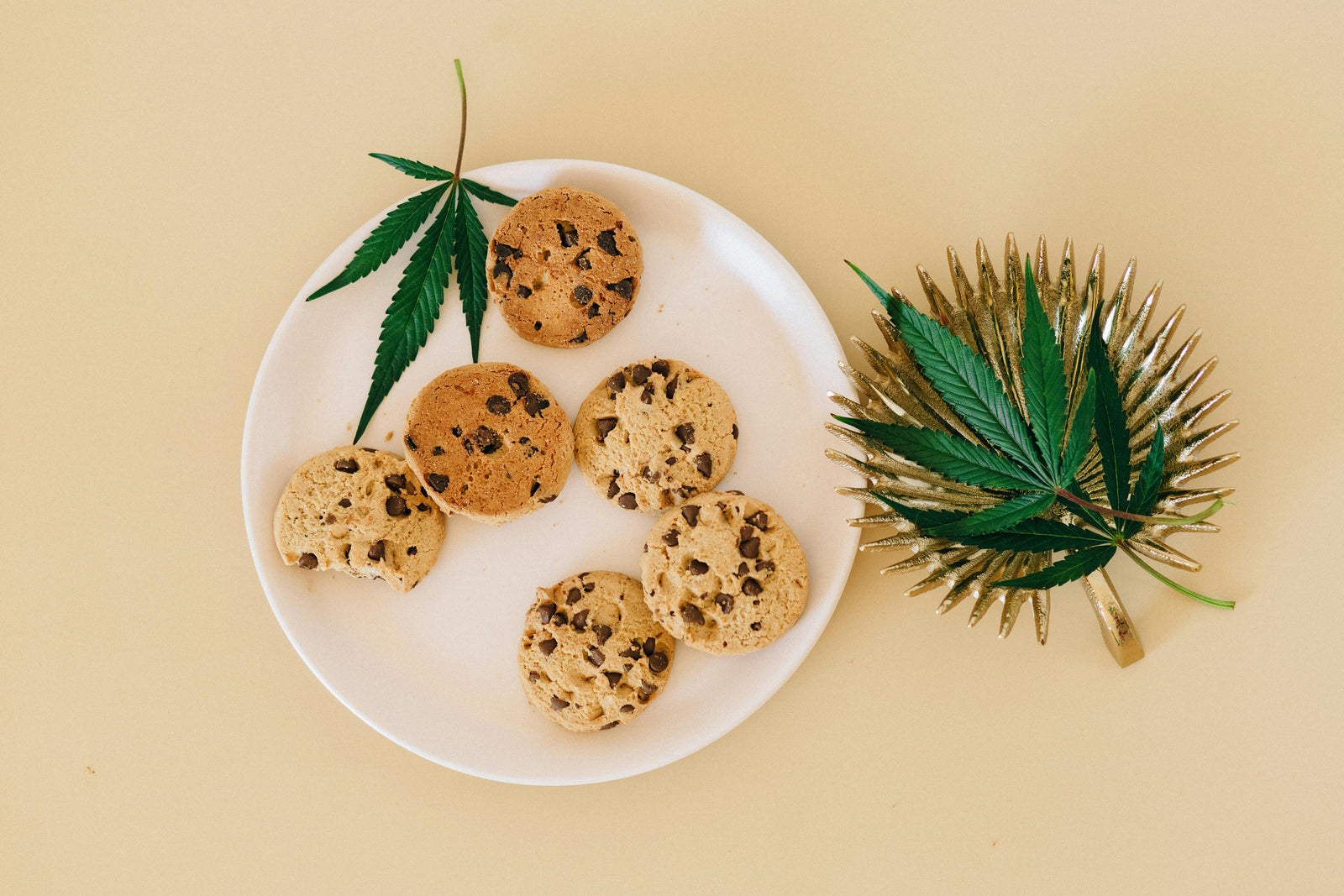
CBD Recipes: 8 easy, measured recipes, butter and decarboxylation (2026)
Practical guide updated October 3, 2026, by Frédéric Penain (Cloud Store CBD).
CBD isn't just for taking drops under the tongue. You can also cook with it, and it is arguably the gentlest and most sustainable way to incorporate it into an evening routine. Before you pull out the cookie cutters, there are two or three things worth understanding: why CBD loves fat, why you need to decarboxylate flowers before using them, and how to dose without messing up your first attempt.
This guide brings together what we’ve learned by cooking our own products over the last three years, cross-referenced with what scientific research says about the thermal stability of cannabinoids (Wang et al., 2016; Pellati et al., 2018). We will cover the basics, two key preparations (CBD butter and oil), how to get the dosage right, eight recipes calculated for approximately 2 mg of CBD per serving, and the mistakes to avoid.
Cooking with CBD at home: the scientific and legal basis
Cannabinoids (CBD, CBG, CBN, CBC, terpenes) belong to a family of lipophilic molecules, meaning they dissolve in fats and very little in pure water. As the scientific review by Pellati et al. published in BioMed Research International in 2018 notes, the aqueous solubility of CBD at 25°C is less than 0.01 mg/mL, while its solubility in vegetable oil is several hundred times higher (Pellati et al., 2018).
In practical terms, this means that infusing CBD flowers in water alone will capture very few cannabinoids. For a recipe to be effective, it needs a fatty medium: butter, oil, whole milk, cream, fresh cheese, egg yolk. The richer the fat content, the better the CBD absorbs into it.
And regarding legality, what do we cook with?
In France, since the decision of the Council of State on January 24, 2022 (No. 444887), the sale and use of hemp flowers and leaves are authorized as long as the delta-9 THC content remains strictly below 0.3% (Légifrance, 2022). This threshold also applies to any homemade preparation based on CBD flowers, resins, or oils: we cook with compliant products, period. To delve into the legal framework, we have a dedicated guide on legal CBD in France in 2026. Note: since May 2026, the ban on edible CBD targets the sale of ingestible products — homemade cooking for personal consumption remains outside this scope.
Source: Pellati et al., BMC Cannabis sativa L. and Nonpsychoactive Cannabinoids, BioMed Research International, 2018 (PMC6275192). Council of State, decision No. 444887, January 24, 2022.
Decarboxylation: why, how, and at what temperature
In the fresh plant, CBD is not truly present: it exists in its acidic form, CBDA (cannabidiolic acid). To release the active CBD as we know it, you must heat the flowers: this is decarboxylation. Without this step, a significant portion of the flowers' potential remains in acidic form, which is not very bioavailable for recipes infused cold or at low temperatures.
The study by Wang, Avula, Wang, Smillie, and Khan published in Cannabis and Cannabinoid Research in 2016 measured the precise kinetics of this conversion (Wang et al., 2016). Their curves confirm what cannabis pastry chefs have known empirically: around 110°C, CBDA converts to CBD with maximum efficiency in 30 to 60 minutes, while above 145°C, the CBD itself begins to degrade.
Time/temperature chart: decarboxylating CBD flowers
| Oven temperature | Duration | Expected effect |
|---|---|---|
| 100°C | 50 to 70 min | Slow but gentle conversion, preserved terpenes |
| 110-120°C | 30 to 40 min | Practical optimum recommended for home cooking (Wang et al., 2016) |
| 140°C | 15 to 20 min | Faster but noticeable loss of aromatic terpenes |
| 160°C and + | irrelevant | CBD begins to degrade and transform into CBN |
Source: Wang et al., Decarboxylation Study of Acidic Cannabinoids, Cannabis and Cannabinoid Research, 2016.
5-minute procedure
- Preheat the oven to 110-120°C, traditional heating (without strong convection/fan that dries it out).
- Lightly crumble the flowers between your fingers. No need to grind them fine: too fine, and you lose terpenes.
- Spread in a thin layer on parchment paper, on a baking sheet or ceramic dish.
- Bake for 30 to 40 minutes, stirring halfway through.
- Remove and let cool: the flower changes from a grassy green to a golden brown; that's the right sign.
CBD butter and oil: the two essential bases
With decarboxylated flowers, you can prepare two bases that cover 90% of uses: CBD butter (perfect for baking, sauces, pasta) and CBD-infused coconut oil (useful for vinaigrettes, cold toppings, or vegan recipes). Both are easy to store and can be dosed to the gram using a kitchen scale.
CBD butter is the legal version of what is often called "Cannabutter": same infusion technique, but with hemp flowers under 0.3% THC. Traditional Cannabutter, made with THC-rich cannabis, remains a prohibited narcotic in France.
Recipe 1 — CBD butter (yield ~250g)
Ingredients
- 10 g of already decarboxylated CBD flowers
- 250 g of high-quality unsalted butter
- 50 cl of water (to buffer heat and facilitate straining)
Preparation
- Melt the butter with the water in a saucepan over very low heat. The mixture temperature must stay between 80 and 95°C; never let it boil.
- Add the crumbled flowers. Stir.
- Let simmer for 2 hours, stirring occasionally with a wooden spoon. Watch carefully: if it smokes or the butter becomes too dark, lower the heat.
- Strain the preparation through a fine mesh sieve lined with cheesecloth (or a clean cloth). Press gently to extract as much as possible.
- Let cool to room temperature, then place in the refrigerator for 4 hours. The butter will solidify on the surface, and residual water will remain underneath: simply remove the disk of infused butter.
Recipe 2 — CBD coconut oil (yield ~200g)
Ingredients
- 10 g of decarboxylated CBD flowers
- 200 g of virgin coconut oil (or olive oil, or MCT)
Preparation
- Melt the oil in a double boiler (bain-marie) at about 80-90°C.
- Add the flowers, stirring to coat them well.
- Keep in the double boiler for 2 to 3 hours. The oil will take on a greenish, then amber tint.
- Strain through cheesecloth. Store in an amber jar in a dry place.
How much CBD per serving? Homemade dosage explained
This is the most frequently asked question. The answer depends on three things: the CBD content of the starting flower, the actual extraction efficiency, and the portion size. We can still provide a reliable framework.
A commercial French CBD flower typically tests between 4% and 12% total CBD (CBDA + CBD), data verifiable on the producer's certificate of analysis. For 10 g of 8% decarboxylated flowers, you therefore have around 800 mg of potential CBD. Homemade extraction in butter, however, is not perfect: scientific literature and practical feedback converge on an effective yield of around 50 to 70% depending on the duration, temperature, and fineness of the crumbling.
The benchmark: approximately 2 mg of CBD per day
In February 2026, the European Food Safety Authority (EFSA) established a provisional safe dose of 0.0275 mg of CBD per kilogram of body weight per day, which is about 2 mg per day for a 70 kg adult (EFSA, 2026). This is the only official European benchmark for CBD consumed as food, and all our recipes are calculated based on it: about 2 mg per serving, one serving per day.
Two honest clarifications. First, this benchmark applies strictly to pure CBD (at least 98%) as a food supplement; for a homemade preparation based on flowers, which also contains other cannabinoids and traces of THC, no safe dose has been established. We therefore treat it as a prudence ceiling, not a recommended dose nor a promise of effect. Second, EFSA specifies that the safety of CBD is not established before age 25, during pregnancy or breastfeeding, nor in case of medication: in these situations, avoid CBD recipes.
Oral intake is slow: wait until the next day before having another portion, and keep a running total of the day's CBD (oil taken in the morning also counts).
Adjusting quantities to your flower's potency
The calculation is simple: CBD per serving = grams of CBD butter × butter potency (mg/g) ÷ number of servings. Potency depends on the CBD level of the flower, indicated on its certificate of analysis:
| Flower CBD level | CBD per gram of butter | CBD butter for 2 mg | For 12 servings at 2 mg |
|---|---|---|---|
| 4% | ≈ 1 mg | ≈ 2 g | 25 g |
| 6% | ≈ 1.4 mg | ≈ 1.4 g | 17 g |
| 8% | ≈ 1.9 mg | ≈ 1 g | 12 g |
| 10% | ≈ 2.4 mg | ≈ 0.8 g | 10 g |
| 12% | ≈ 2.9 mg | ≈ 0.7 g | 8 g |
Using commercial CBD oil
Oil should be dosed by the drop, never by the spoonful: a 10 ml bottle contains about 200 drops (details on conversions in our CBD oil dosage guide). To stay around 2 mg per serving, one drop can be distributed in a dish for several people:
| Oil concentration | CBD per drop | 1 drop for... |
|---|---|---|
| 5% | ≈ 2.5 mg | 1 serving |
| 10% | ≈ 5 mg | 2 to 3 servings |
| 20% | ≈ 10 mg | 5 servings |
| 30% | ≈ 15 mg | 7 to 8 servings |
8 easy CBD recipes, dosed at 2 mg per serving
Each recipe is calculated for approximately 2 mg of CBD per serving. Quantities assume CBD butter and infused oil prepared as above with an 8% flower (≈ 1.9 mg per gram of butter, ≈ 2.4 mg per gram of oil), or 10% commercial CBD oil (≈ 5 mg per drop). With a different flower or oil, the tables above provide the correct quantities.
| Recipe | Servings | CBD used | CBD per serving | Cooking |
|---|---|---|---|---|
| Cookies | 12 | 12 g CBD butter | ≈ 1.9 mg | 170°C, 10 to 12 min |
| Brownies | 16 squares | 16 g CBD butter | ≈ 1.9 mg | 170°C, 20 to 25 min |
| Cocoa energy balls | 12 | 10 g infused coconut oil | ≈ 2 mg | none |
| Hot chocolate | 4 cups | 4 g CBD butter | ≈ 1.9 mg | low heat |
| Golden milk | 4 cups | 4 g CBD butter | ≈ 1.9 mg | low heat |
| Pesto | 4 | 2 drops 10% oil | ≈ 2.5 mg | none |
| Vinaigrette | 4 | 2 drops 10% oil | ≈ 2.5 mg | none |
| Hummus | 6 | 3 drops 10% oil | ≈ 2.5 mg | none |
1. CBD Butter Cookies (12 cookies)
Prep 15 min · cook 10 to 12 min at 170°C · ≈ 1.9 mg of CBD per cookie
Ingredients
- 12 g of CBD butter and 113 g of unsalted butter, softened (125 g total)
- 100 g of brown sugar and 50 g of white sugar
- 1 egg
- 200 g of flour, 5 g of baking powder, 1 pinch of salt
- 150 g of chocolate chips
Preparation
- Mix the two butters thoroughly, then add the sugars and whisk until creamy.
- Add the egg, then the flour, baking powder, and salt. Fold in the chocolate chips.
- Form 12 balls of equal weight (about 60 g each) on a baking sheet lined with parchment paper.
- Bake for 10 to 12 minutes at 170°C: the edges should be golden, the center soft. The inside of the dough stays much cooler than the oven.
2. CBD Butter Brownies (16 squares)
Prep 15 min · cook 20 to 25 min at 170°C · ≈ 1.9 mg per square
Ingredients
- 16 g of CBD butter and 134 g of unsalted butter (150 g total)
- 200 g of 70% dark chocolate
- 150 g of sugar
- 3 eggs
- 70 g of flour, 1 pinch of salt
- 80 g of chopped pecans (optional)
Preparation
- Melt the chocolate with both butters in a double boiler over low heat, stirring.
- Whisk the eggs and sugar, add the melted chocolate, then the flour, salt, and nuts.
- Pour into a 20 cm square pan lined with parchment paper. Bake for 20 to 25 minutes at 170°C.
- Let cool completely, then cut into 16 equal squares (4 × 4): even cutting ensures an even dose.
3. No-Bake Cacao Energy Balls (12 bites)
Prep 15 min · no bake · ≈ 2 mg per bite
Ingredients
- 200 g of pitted Medjool dates
- 100 g of almonds or cashews
- 2 tablespoons of unsweetened cacao
- 10 g of CBD-infused coconut oil (recipe 2 above)
- 1 pinch of salt, shredded coconut for coating
Preparation
- Pulse the almonds into a coarse powder.
- Add the dates, cacao, salt, and the infused coconut oil, melted over very low heat if solid. Blend until a uniform dough forms.
- Weigh the dough, divide into 12 equal-weight balls, and roll them in shredded coconut.
- Chill for 30 minutes. Without cooking, the CBD and terpenes remain intact.
4. CBD Hot Chocolate (4 cups)
10 min · low heat, do not boil · ≈ 1.9 mg per cup
Ingredients
- 1 liter of whole milk
- 80 g of 70% dark chocolate, chopped
- 2 tablespoons of cocoa powder, sugar to taste
- 4 g of CBD butter
Preparation
- Heat the milk over low heat with the cocoa and sugar, whisking, without letting it boil.
- Remove from heat, add the chopped chocolate and CBD butter, then whisk for one minute: the fat in the milk and chocolate distributes the CBD.
- Divide into 4 equal cups.
5. Turmeric Golden Milk (4 cups)
10 min · low heat · ≈ 1.9 mg per cup
Ingredients
- 1 liter of whole milk or coconut beverage
- 2 teaspoons of turmeric, 1 of cinnamon, ½ of ginger powder, 1 pinch of black pepper
- Honey to taste
- 4 g of CBD butter
Preparation
- Heat the milk with the spices for 5 minutes at a simmer, without boiling.
- Remove from heat, add the CBD butter and honey, then whisk.
- Strain if needed and divide into 4 equal cups.
6. CBD Pesto (4 servings)
10 min · no bake · ≈ 2.5 mg per serving
Ingredients
- 50 g fresh basil, 30 g toasted pine nuts, 30 g grated Parmesan, 1 garlic clove
- 80 ml olive oil, salt
- 2 drops of 10% CBD oil
Preparation
- Blend the basil, pine nuts, Parmesan, garlic, and olive oil.
- Add the 2 drops of CBD oil and blend for a few more seconds.
- Mix into 4 portions of warm, not boiling, pasta just before serving.
7. CBD Vinaigrette (4 servings)
3 min · no bake · ≈ 2.5 mg per serving
Ingredients
- 3 tablespoons of olive oil, 1 of balsamic vinegar, 1 teaspoon of mustard
- Salt, pepper
- 2 drops of 10% CBD oil
Preparation
- Emulsify the olive oil, vinegar, mustard, salt, and pepper.
- Add the 2 drops of CBD oil last, whisk, and dress a salad for 4.
8. CBD Hummus (6 servings)
10 min · no bake · ≈ 2.5 mg per serving
Ingredients
- 400 g cooked chickpeas, drained
- 2 tablespoons of tahini, juice of one lemon, 1 garlic clove
- 3 tablespoons of olive oil, ½ teaspoon cumin, salt, 2 to 4 tablespoons cold water
- 3 drops of 10% CBD oil
Preparation
- Blend all ingredients except the CBD oil, adding water bit by bit until the desired texture is reached.
- Add the 3 drops of CBD oil and blend for another 10 seconds.
- Divide into 6 portions.
Doses calculated using CBD butter at ≈ 1.9 mg/g and coconut oil infused at ≈ 2.4 mg/g (10 g of 8% flowers, 60% yield), and 10% CBD oil at ≈ 5 mg per drop (200 drops per 10 ml). A margin of error of ±30% is possible with home preparations.
The 6 mistakes to avoid when cooking with CBD
- Cooking above 180°C. Beyond this, CBD degrades significantly and a portion converts into CBN, which has a different effect profile. Adapt recipes or add CBD at the end of cooking.
- Skipping flower decarboxylation. Without this step, you are mostly working with CBDA, which is not very active when cold—unless you are specifically seeking CBDA for its own properties.
- Working without fat. Infusing in pure water captures less than 10% of the available CBD. Always pair with a fat from the start.
- Overdosing. One portion per day, calculated around 2 mg (EFSA 2026 benchmark), counting all CBD consumed that day. Oral intake is slow; do not consume another portion immediately after.
- Cooking with untested flowers. Without a certificate of analysis (CoA), you won't know the actual CBD rate or 0.3% THC compliance. You must read a CoA before purchasing. We have a guide on how to read a CBD oil label which also applies to flowers.
- Improper storage. CBD butter keeps for 1–2 months in the fridge, 6 months in the freezer. Oil keeps for 4–6 months away from light. Beyond this, oxidation leads to loss of activity.
Flower, resin, or oil: which to choose for cooking?
Three raw materials, three distinct uses. The choice depends on the visual result, time investment, and budget.
| Material | When to use | Advantage | Limitation |
|---|---|---|---|
| Flower | Butter, infused oil, milk infusion | Full aromatic profile (terpenes), artisanal finish | Requires decarboxylation + filtering |
| Resin | More concentrated recipes, chocolate, spreads | Higher concentration, less material needed | Pasty texture to emulsify, earthier profile |
| CBD Oil (full/broad spectrum) | Vinaigrettes, toppings, smoothies, cold additions | Precise dosing (mg / drop), zero prep steps | Taste can be strong, not suitable for baked goods |
If you're a beginner, starting with CBD oil lets you test without "wasting" a flower. To go further with flowers, see our guide on choosing CBD flowers. To understand the differences between full spectrum, broad spectrum, and isolate before choosing an oil, read full spectrum, broad spectrum, or isolate. On the shop side, we have grouped all CBD flowers, resins, and CBD oils that are 0.3% THC compliant.
Storage and shelf life of CBD preparations
Three enemies: light, heat, oxygen. Properly stored CBD butter or oil retains its activity for several months. Poorly stored, they lose CBD and aroma in weeks.
| Preparation | Fridge | Freezer | Pantry |
|---|---|---|---|
| CBD butter | 1 to 2 months | 6 months | Not recommended |
| CBD coconut oil | 4 to 6 months | 1 year | 3 to 4 months in a dark, airtight jar |
| Ready infusion | Max 48 hours | 1 month | No |
| Cookies/pastries | 5 days | 2 months | 3 days in an airtight container |
For storing dry flowers (before cooking), proper habits regarding humidity, light, and jars are detailed in our flower and resin storage guide.
CBD food and driving: what you need to know
One last thing that comes up often. Legal CBD in France contains up to 0.3% THC. This residual amount, even if tiny, can be detected by saliva or blood tests, especially after oral ingestion which accumulates. Roadside tests in France detect THC, not CBD. Before driving after a CBD dinner, it's better to know the thresholds and potential recourse: we have dug into this topic in our guide CBD and driving in France.
FAQ — Cooking with CBD
Which easy CBD recipe should I start with?
A no-bake recipe using CBD oil, like vinaigrette or pesto: 2 drops of 10% oil spread over 4 portions, which is about 2.5 mg of CBD per portion, without the risk of heat degrading the CBD. For baking, CBD butter cookies (12 g of infused butter for 12 cookies) result in about 2 mg per cookie.
How do I calculate the CBD dose in a recipe?
Multiply the amount of CBD butter (in grams) by its milligrams-per-gram content, then divide by the number of portions. With 10 g of 8% flowers in 250 g of butter and a yield of about 60%, the butter contains about 1.9 mg of CBD per gram: 12 g for 12 cookies gives about 2 mg per cookie. The actual rate of the flower is found on its certificate of analysis, and homemade preparations can vary by ±30%.
Can CBD be used in all recipes?
Yes, in most sweet or savory recipes, provided you associate the CBD with a fat like butter, coconut oil, or olive oil. Because cannabinoids are lipophilic (Pellati et al., 2018), a recipe without fat captures very little CBD: less than 10% of the available amount passes into the preparation.
Does cooking destroy CBD?
Not systematically, but beyond 180°C, degradation becomes significant. The study by Wang et al. (2016) on cannabinoid kinetics confirms a stable window up to 145°C, followed by a rapid loss of CBD and a progressive conversion to CBN. To preserve activity, aim for gentle cooking (cookies at 170°C, coated pastries) or add CBD at the end of preparation.
Can I cook directly with CBD flowers without decarboxylation?
Technically yes, but the yield drops significantly. Without prior decarboxylation, cannabinoids remain mostly in their acidic form (CBDA). Conversion to active CBD requires a stage at 110–120°C for 30 to 40 minutes (Wang et al., 2016). If the recipe includes a long cook at a low temperature (e.g., butter infused for 2 hours), some will convert during the process, but it's less reliable.
What is the best base for cooking with CBD?
Butter is the classic for baked goods (cookies, brownies, shortbread). Coconut or olive oil is more versatile: vinaigrettes, toppings, vegan recipes, pesto. Whole milk works very well for hot drinks (golden milk, hot chocolate). The common criteria remains fat content: the higher it is, the better the CBD absorption.
What is the CBD dose per serving for a beginner?
No more than about 2 mg of CBD per day: this is the provisional safe limit set by EFSA in February 2026 for a 70 kg adult (0.0275 mg per kilo per day). Our recipes are calculated for 2 mg per portion, with one portion per day. CBD safety is not established for those under 25, during pregnancy or breastfeeding, or for those on medication.
Can I drive after eating a CBD cookie?
CBD itself does not impair alertness at standard culinary doses. However, legal CBD flowers and resins contain up to 0.3% THC, and this residual amount can be detected by roadside saliva tests. Details on thresholds, detection times, and possible recourse are in our guide CBD and driving.
CBD "Marrakech" butter: what dosage per person?
With CBD butter prepared using 10 g of 8% flowers per 250 g of butter, count about 1 g of CBD butter per person to stay around 2 mg of CBD, the prudent EFSA benchmark. For 12 portions: 12 g of CBD butter, completed with regular butter. Traditional "Marrakech" butter containing THC is a controlled substance prohibited in France: we are only talking about the CBD version here, under 0.3% THC.
How long does homemade CBD butter last?
1 to 2 months in the refrigerator in an opaque airtight container, up to 6 months in the freezer portioned into ice cubes. Beyond that, light and oxygen gradually degrade the cannabinoids: the color darkens, the aroma fades, and the effect diminishes. Storing butter at room temperature is not a good idea, as oxidation occurs too quickly.
Information for educational purposes. CBD is not a medicine and does not replace medical advice. Cooking with CBD remains for private use, using products compliant with the French 0.3% delta-9 THC threshold.