
How to choose your CBD flower: aromas, cultivation, potency, and style (2026 guide)
Reading time: ~9 min, Cloud Store CBD practical guide · updated on August 3, 2026.
You land on an online CBD flower shop and thirty varieties flash by: Bubble Gum, Strawberry Diesel, Amnesia, Gorilla Glue, Lemon Zkittlez, OG Kush. Indoor, greenhouse, hydroponic, small buds. Potency 8%, 14%, 22%. How do you know which one is right for you when you don't have three years of experience under your belt?
The short answer: in almost all cases, what you'll see in French online shops will be indoor. Out of the 22 flowers in our own catalog, 21 are cultivated hydroponically indoors, 1 in a greenhouse, and none outdoors. So the real question isn't "indoor or outdoor," but what indoor cultivation concretely changes — and at what real price per gram.
This guide lays out the true variables that matter in your choice: the aromatic profile (by far the first priority), the cultivation method, the cannabinoids displayed, and legal compliance. With references to authoritative sources: Order of December 30, 2021 (Légifrance, consulted on May 5, 2026), Russo 2011 on the entourage effect of terpenes (PubMed), and the ANSM file dedicated to cannabidiol.
The goal is not to sell you the most expensive variety. It's to give you the benchmarks so you don't regret your order, whether it's €3 or €12 per gram.
Quick Answer
• Indoor by default: 21 of the 22 flowers in our catalog are indoor hydroponic, 1 greenhouse, 0 outdoor. In France, outdoor is marginal in online CBD sales.
• Number one priority: the aromatic profile. If you don't like the smell, no matter the potency or cultivation method, the bag will end up forgotten.
• Four families: fruity/candy, citrus, creamy/dessert, diesel/gassy. Each family carries different dominant terpenes.
• Indoor vs greenhouse: not a question of absolute quality, but of visual finish, consistency, and price. Indoor is denser and more stable, greenhouse offers better value for money.
• CBD levels: 8 to 22% in flower, but a well-produced 14% variety can outperform a poorly done 20%. Percentage is not the only indicator.
• Compliance: finished product < 0.3% THC, certificate of analysis available. Without these two elements, move on.
Aroma first: the four families to know
More than 90% of the CBD experience revolves around terpenes. These are the aromatic molecules that give cannabis its fruity, citrusy, or diesel notes. According to the Russo review (2011) on PubMed, terpenes don't just smell good: they also modulate how we perceive cannabinoids (the entourage effect). This is why, at the same potency, two varieties can produce very different sensations.
Four main families cover most of the legal French market:
| Family | Dominant Terpenes | Typical Notes | Reference Varieties |
|---|---|---|---|
| Fruity / candy | Myrcene, limonene | Candy, tropical, sweet, gourmet | Bubble Gum, Zkittlez, Rainbow |
| Citrus | Limonene, terpinolene | Lemon, zest, fresh, vibrant | Lemon Zkittlez, Amnesia, Super Lemon |
| Creamy / dessert | Linalool, caryophyllene | Vanilla, cake, ice cream, soft | Ice Cream, Sorbet, Gelato, Cookies |
| Diesel / gassy / earthy | Caryophyllene, humulene, pinene | Gasoline, earth, spices, woody | Sour Diesel, OG Kush, Strawberry Diesel |
The right approach when looking at a product sheet: start with the aroma section. Cloud Store always details the aromatic profile at the top of the sheet, with dominant terpenes when analysis has identified them. If the aromatic description is vague (or absent), it's a warning sign: the producer doesn't master what they're selling, or the batch is too heterogeneous to be precisely described.
Want to see the complete overview of available flowers?
Discover our CBD flowersIndoor, greenhouse, outdoor: what really changes
The cultivation method determines three concrete things: the visual appearance of the buds, the consistency from batch to batch, and the price per gram. Nothing more. No method is intrinsically superior: it all depends on the compromise you're looking for.
Indoor (interior, hydroponic or soil)
The plant grows indoors under lights, with precise control of humidity, temperature, and photoperiod. The result: dense, trimmed buds, with visible trichomes and strong consistency from batch to batch. This is what drives up the price, because energy costs and labor are high. In our catalog, an indoor flower starts at around €5.90/g for the discovery format (1.5g) and goes down to about €3.70/g for the 50g format — detailed figures are below. Ideal for those who want a very visual flower with a stable output.
Greenhouse (under cover)
A compromise between natural light and protection. Buds sometimes less dense than indoor, but aromas often more expressive thanks to the full solar spectrum. Typical prices in France: €3 to €7/g. This is the segment where the quality-price ratio is most interesting for regular consumers, provided the producer is serious about selecting mother plants.
Outdoor (open air)
Plant exposed to sun and natural conditions. Buds are more airy, sometimes less aesthetic, with greater variability from season to season. Lowest prices (sometimes less than €3/g for small buds). Suitable for those who prioritize quantity or use in infusions where visual appeal matters less.
What about small buds?
Small buds do not refer to a different quality: they are smaller-sized flowers from the same batch, sold cheaper because they are less aesthetically pleasing. Aromatically and chemically, it's the same product. Excellent value for money for those who want to taste a variety without paying for the visual.
What does a real indoor catalog look like?
The price ranges circulating online ("€5 to €12/g") mix very different formats. A price per gram only makes sense when associated with a quantity. Here are our actual figures, taken from our own catalog on August 3, 2026, rather than an unverifiable market average.
Distribution of the 22 flowers in the catalog (excluding pre-rolls):
- Cultivation: 21 indoor hydroponic, 1 greenhouse, 0 outdoor.
- CBD levels: 14 flowers at 10-15%, 6 flowers at 16-21%, 1 at more than 50% (Moonrock, an enriched flower — a special case).
- Dominant aromatic families: creamy (7 varieties), citrus (6), fruity (6), pine (6), tangy (5).
- Origin: 15 France, 4 Switzerland, 3 multi-origin.
The most surprising point: no outdoor flowers. The indoor / greenhouse / outdoor distinction is useful to understand, but in online CBD sales in France, it practically boils down to indoor, with greenhouse in the small bud segment.
The price per gram decreases by 35 to 50% depending on the quantity
This is the variable that comparisons often forget. The same product does not cost the same price per gram depending on the format purchased. Price scale observed on four references from our catalog:
| Flower | Cultivation | 1.5-3 g | 10 g | 50 g | Difference |
|---|---|---|---|---|---|
| Amnesia US (16-21%) | Indoor | €5.90/g | €4.70/g | €3.70/g | -37% |
| Bubble Gum (10-15%) | Indoor | €5.50/g | €4.10/g | €3.20/g | -42% |
| MAC 1 Small Bud | Indoor | €2.25/g | €1.75/g | €1.25/g | -44% |
| Small Bud Gelato (16-21%) | Greenhouse | €1.90/g | €1.30/g | €0.90/g | -53% |
Three practical takeaways from this table:
- A top-tier indoor flower in small format costs less than €6/g, not €12. The high ranges seen elsewhere correspond to price points we do not offer.
- The indoor / small bud difference is a difference in size, not quality. At €2.25/g vs €5.50/g, MAC 1 small bud comes from the same batch as MAC 1 whole flower.
- Buying 50g is only cost-effective if you consume it quickly. A flower loses its terpenes in 3-4 months even when properly stored: the 40% price saving is nullified if the bag goes stale.
Prices recorded on August 3, 2026, from our catalog, subject to change. The table serves as a reference for price structure, not a price list.
To see available flowers with their potency, aromatic family, and price per format: see all our CBD flowers
Reading potency: CBD, CBG, CBN, and the 0.3% THC threshold
A reliable product sheet systematically displays four pieces of data: CBD level, THC level, potential presence of other cannabinoids (CBG, CBN), and the batch number with a certificate of analysis. Without these four elements, you're in a gray area.
| Cannabinoid | Typical Range in CBD Flower | Reported Effect | To Monitor For |
|---|---|---|---|
| CBD | 8 to 22% | Relaxation, stress management | Everyone, it's the main active compound |
| THC | < 0.3% (mandatory) | Psychoactive above the threshold | Check certificate before purchase |
| CBG | 0.5 to 2% | "Clarifying" profile, less sedative | Daytime use, concentration |
| CBN | 0.2 to 1.5% | More sedative profile, often associated with sleep | Evening use |
The legal threshold of 0.3% THC in the finished product is non-negotiable. It is set by the order of December 30, 2021 (Légifrance), in the consolidated version applicable since the Conseil d'État ruling of December 29, 2022. A flower purchased in a legal shop in France must necessarily be below this threshold, attested by an independent laboratory certificate of analysis.
Regarding the CBD level itself, there's a classic trap: the race for the highest percentage. A 22% variety that's averagely produced will often yield a duller sensation than a 14% variety that's well-trimmed, dried, and stored. Potency is an indicator, not a trophy. If potency remains your criterion, we have ranked the most potent CBD flowers in our selection.
CBD is not a medicine
The ANSM (consulted on May 5, 2026) reminds that no CBD flower sold in shops in France can be presented with a therapeutic claim. The sensations described here are those reported by users and scientific literature, not promises of treatment.
Appearance, trimming, sizes: what you see, what you don't see
A few practical points when looking at product photos, or the flower you receive:
- Trimming: the fewer leaves remaining around the bud, the more careful the post-harvest work has been. A very leafy flower is not necessarily bad, but it has often been machine-trimmed rather than hand-trimmed.
- Density: compact buds generally indicate good light at the end of the cycle (especially indoor). Airy buds can be a sign of outdoor cultivation or a botched end of cycle.
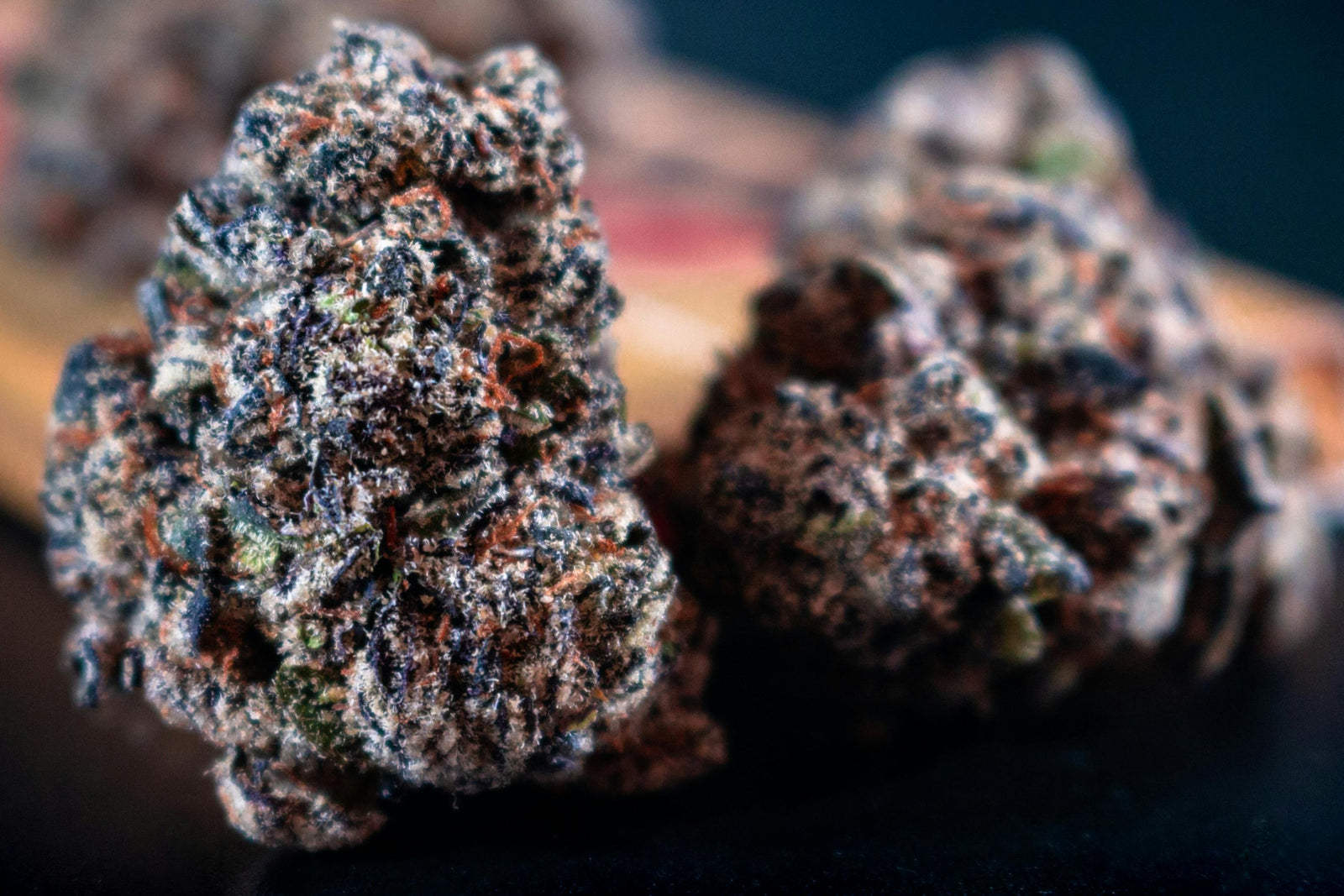
- Color: various greens, sometimes purple hues on certain genetics (Purple Punch, Zkittlez). Be wary if the flower is uniformly brown or yellowed without a genetic reason: a possible sign of poor preservation.
- Trichomes: these small "crystals" on the bud are a sign of a fresh and well-loaded flower. The denser and shinier they are, the more recent the flower.
- Smell: upon receipt, a fresh flower immediately releases its aromatic profile when opened. A smell of dry hay or cardboard indicates too long a drying process or poor storage.
A good producer photographs their flowers with neutral light and a plain background. If all photos are on a dark background with saturated contrasts, it's more a marketing signal than a quality signal.
Choosing according to your profile: beginner, intermediate, expert
You're just starting (you've never tried or very little)
The classic mistake: buying 25g of the same strain on the first order. Opt for fruity or creamy profiles, which are milder in aroma and more widely appealing. Go for small quantities (3 to 5g) of two or three different strains to identify your preferences. A greenhouse strain with 12-14% CBD is an excellent starting point: affordable, expressive, without being overwhelming.
You are an intermediate user (you have already tried 5-10 strains)
You probably know which aromatic family appeals to you. Refine your search by exploring sub-profiles: if you like creamy, compare Ice Cream Cake and Gelato. If you like diesel, compare Sour Diesel and Strawberry Diesel. At this stage, indoor growing begins to make sense for consistency and visual appeal.
You are an expert (collector, connoisseur)
You probably already look at terpene profiles in addition to CBD levels. You know how to identify a too-quick drying process, you compare producers, and you sometimes request analysis certificates beforehand. For you, rare strains (limited editions, uncommon genetics) and high-end hydroponic indoor strains are the natural segment.
Check legal compliance in 30 seconds
Three quick checks to make before clicking "add to cart":
- Mention "< 0.3% THC" visible on the product page, ideally with a link to or download of the laboratory analysis certificate (COA).
- Declared origin: strain listed in the European hemp varieties catalogue (cf. European Commission common catalogue, consulted on May 5, 2026), country of cultivation mentioned.
- Seller's identity: verifiable SIREN number, complete legal notices, accessible contact information. An anonymous shop or one hosted outside the EU is a red flag.
To learn more about the legal framework and cultivation in France, the specialized guide is here: CBD cultivation in France and legality. For details on driving after consumption, see the CBD and driving guide.
Test without breaking the bank: the logic of discovery packs
The most effective approach to identify your preferences without emptying your budget: a discovery pack that groups several varieties in small formats. Cloud Store offers a discovery pack of 1.5g of each variety (10 or 15 flowers and resins), which allows you to sample the four aromatic families for the price of a standard order. This is also the format we recommend when someone gives CBD as a gift: avoid trying to guess, let the recipient choose.
To understand how CBD works overall before choosing a specific flower:
Read: all the benefits of CBD (pillar guide)FAQ: choosing your CBD flower
What is the best CBD flower for beginners?
Indoor or greenhouse, which to choose?
Is the CBD level the most important criterion?
Are small buds of lesser quality?
How to know if a flower is fresh?
Are purple-hued strains stronger?
How many different strains should I keep in stock?
Should I buy in large quantities to save money?
To go further
Four useful extensions after this guide: understanding why a flower can display more than 50% CBD, knowing which one is actually the most potent in the catalog, avoiding loss of aromas once the bag is opened, and reviewing what the literature says about CBD uses.
- CBD Flowers vs. CBD Resins: What are the differences?
- How to store your CBD flowers and resins to preserve their aromas
- Boosted CBD flower: how it's made
- What is the most potent CBD flower?
- Benefits of CBD: the sourced pillar guide
- Légifrance, decree of December 30, 2021 on hemp: legifrance.gouv.fr
- Conseil d'État, decision n° 444887 of December 29, 2022: conseil-etat.fr
- ANSM, cannabidiol file: ansm.sante.fr
- Russo E.B., 2011, "Taming THC: potential cannabis synergy and phytocannabinoid-terpenoid entourage effects": PubMed
- European Commission, common catalogue of hemp varieties: food.ec.europa.eu
Disclaimer: This guide is for informational purposes only and does not constitute medical advice. CBD flowers are not medicines. If you have any doubts about your personal situation, consult a healthcare professional. Update: August 3, 2026, with price and catalog composition updated to this date.