
How to store your CBD flowers and resins: complete guide 2026
Reading time: ~8 min, practical guide Cloud Store CBD · updated on May 5, 2026.
You've invested in a variety you love. Three weeks later, the smell is gone, the flower crumbles, and the experience is nothing like the first use. This is not inevitable: CBD storage relies on three simple variables (light, humidity, oxygen) and accessible containers. Well managed, a flower retains its profile for 4 to 6 months and a resin for 6 to 12 months.
This guide presents the methods that really work, with the quantified thresholds from the literature: Milay et al. 2020 on post-harvest storage conditions (PubMed), Russo 2011 on terpene stability, and Boveda 62% RH specifications (accessed May 5, 2026). Cloud Store advice then follows, calibrated for what works in real conditions.
Quick answer
• Three enemies: light (UV), oxygen, heat. Fourth factor to monitor: humidity (too dry or too humid, both degrade).
• Optimal method: tinted or opaque glass jar, airtight seal, in a cupboard at 18-21 °C, away from light. With a Boveda 62% RH for flowers.
• Optimal duration: 3-6 months for flowers, 6-12 months for resins, under correct storage conditions.
• To avoid: zip bag for more than 3 weeks, fridge (condensation), freezer (weakens trichomes), car (thermal variations).
• Signs of degradation: hay smell, brittle texture, white spots (mold). If you see these signs, do not consume.
The four enemies of CBD: why poor storage is costly
The study Milay et al. (2020, PubMed) documented the degradation of cannabinoids under several storage conditions: at room temperature with light exposure, CBD loses up to 13% of its concentration in four years, and the terpene profile degrades much faster (typically a few months). Terpenes are the most volatile fraction: what evaporates first is the aroma.
1. Light (especially UV)
UV breaks the chemical bonds of cannabinoids and terpenes. A flower exposed to direct light gradually loses its potency and aromas. Direct sunlight is the worst (energy radiator + UV), but prolonged exposure to artificial light is also sufficient.
2. Oxygen
Oxidation slowly transforms cannabinoids (THC oxidizes into CBN). As terpenes are volatile, they evaporate each time the container is opened. A bag opened regularly without an airtight seal loses aromas with each exposure.
3. Heat
Above 25 °C, terpenes evaporate faster and cannabinoids degrade. A flower stored near a radiator or in a car in summer can lose half its value in a few weeks.
4. Humidity (too much or too little)
Too much humidity (above 65% RH) promotes mold, especially on flowers. Too little (below 55%) dries out the material, the buds crumble, and terpenes evaporate faster. The optimal window is narrow: 58 to 64% relative humidity, with 62% as a common target.
The glass jar: the reference method
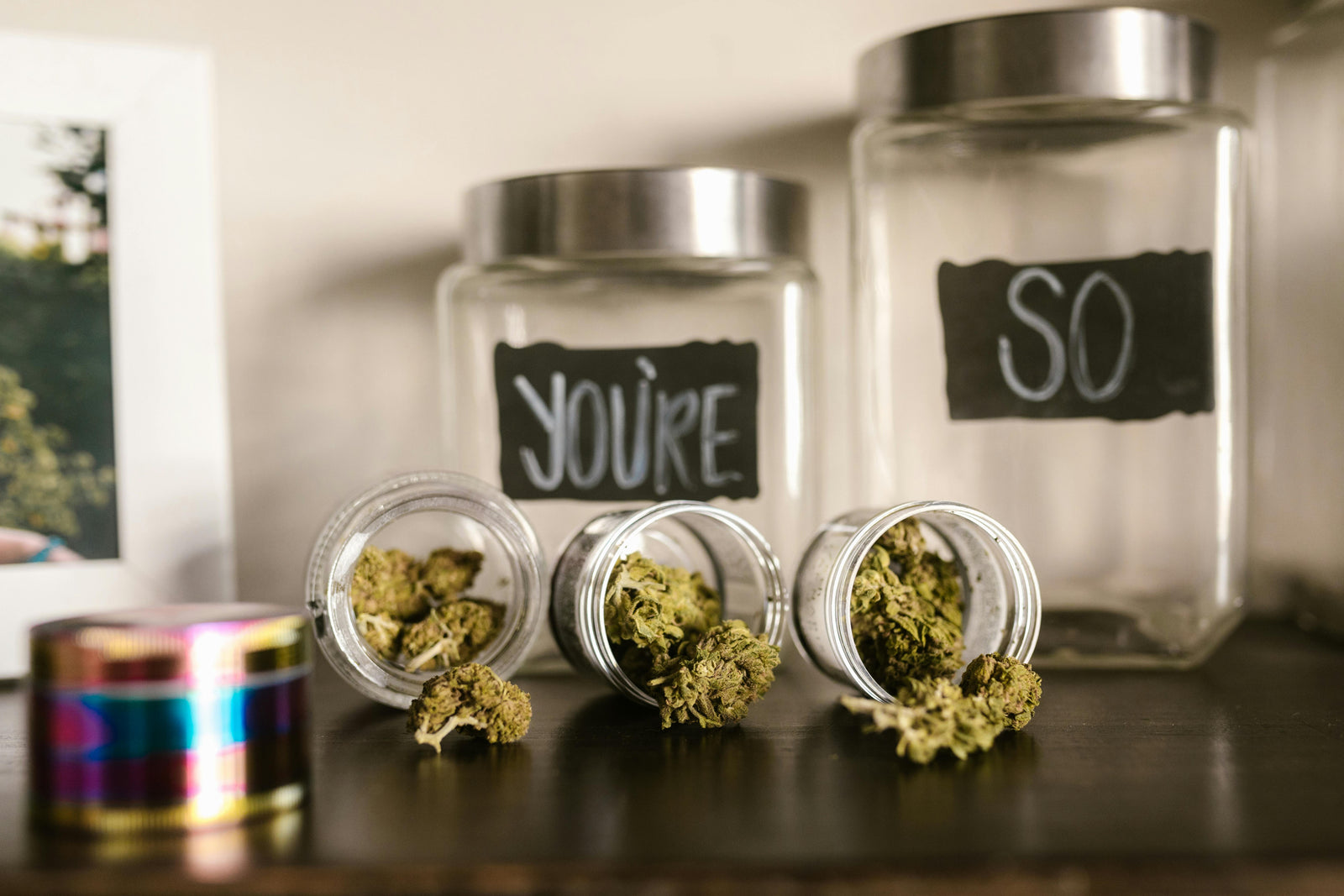
The tinted or opaque glass jar, with an airtight seal, is the standard for storing CBD flowers. Three key properties:
- Neutral material: glass does not release odors or compounds that contaminate aromas (unlike some low-quality plastics).
- Airtight seal: limits oxygen and stabilizes internal humidity.
- Light protection: tinted glass (amber, dark green, violet) or opaque jar to block UV.
How to use it
- Choose a jar sized appropriately for the volume stored: fill between 70 and 90% of the volume. A jar that is too large leaves too much air, a jar that is too small compresses the buds.
- Pour without packing, leaving 1-2 cm of free space at the top.
- Close hermetically. Check the seal regularly, especially on used jars.
- Store in a closed cupboard, at room temperature (18-21 °C).
- Limit unnecessary openings: each opening renews the air and releases terpenes.
Budget
Count on 5 to 15 € for a quality jar (Le Parfait, Mason Jar, or dedicated cannabis jars like Re:Stash). A good jar will last for years if its seal is taken care of.
Humidity control with Boveda 62%
Boveda is the reference brand for humidity regulating sachets used in premium tobacco and cannabis. According to Boveda documentation (accessed May 5, 2026), the 62% RH (relative humidity) sachet automatically maintains the air at this value in an airtight container: it releases water if the air is too dry, and absorbs it if the air is too humid.
Why 62% specifically?
This is the relative humidity at which cannabis flowers retain their structure (not too dry to crumble, not too humid to develop mold). Users with a taste for more expressive aromas sometimes prefer 65%, those who want a drier burn go down to 58%. For 95% of cases, 62% is the right choice.
How to use it
- Slip a Boveda 62% RH sachet into the jar, on top of or next to the flowers.
- Close hermetically.
- The sachet equilibrates in a few hours to a few days depending on the volume.
- Replace every 2 to 4 months (depending on jar volume and opening frequency). The sachet becomes hard and rigid when used up.
Budget: 5-10 € for a pack of 5 sachets, or less than 2 € per month for an average jar. This is probably the best investment/aromatic preservation ratio on the cannabis storage market.
Boveda also works for resins
Less critical than with flowers (resin is less sensitive to humidity), but useful for pressed resins. Prevents excessive hardening of greasy resins and sticky softening of foamy resins in an environment that is too dry or too humid.
Temperature and location: where exactly to store?
Ideal temperature: 18-21 °C, stable
Stability matters as much as the absolute value. A cellar at a constant 16 °C preserves better than a cupboard at 22 °C that rises to 28 °C in summer and drops to 14 °C in winter. Thermal variations make the jar breathe and accelerate oxidation.
Places to avoid
- Near a heat source (radiator, oven, hob, window exposed to the sun).
- Refrigerator: condensation with each removal creates harmful variable humidity, and the cold, dry air of the compartment also dries out the material faster than at room temperature.
- Freezer: extreme cold weakens the trichomes (the "resin" on the surface of the buds), which can detach at the slightest shock. This effect is aggravated on very dense flowers.
- Car: massive thermal variations, especially in summer. To be avoided for storage, acceptable for occasional transport.
- Bathroom: humidity variations with showers, sometimes 70-80% RH, which exceeds the safety window.
Recommended places
- Closed cupboard in a tempered room (bedroom, living room).
- Desk drawer or sideboard.
- Stable tempered cellar (ideal if it remains around 16-18 °C all year round).
- Opaque shelf in a kitchen cupboard away from heat sources.
Differences between flowers and resins: specific durations and precautions
| Criterion | CBD Flowers | CBD Resins |
|---|---|---|
| Optimal duration | 3 to 6 months | 6 to 12 months |
| Overall sensitivity | High (volatile terpenes, airy structure) | Medium (compression reduces exposed surface) |
| Main risk | Drying out, loss of aromas, mold | Hardening (dry), softening (hot) |
| Boveda recommended | Yes, strongly | Optional depending on texture |
| Specific tip | Indoor > greenhouse in long-term stability | Parchment paper for greasy ones, direct jar for friable ones |
Indoor flowers (denser and more uniform) generally hold up better over time than greenhouse flowers, under identical storage conditions. For resins, separating textures is useful: a greasy resin (3x Filtered) wrapped in parchment paper and then placed in the glass jar limits texture transfers between products if you store several.
Alternatives to glass jars: zip bags, CVault, vacuum sealing
Airtight zip bag
Practical, economical, perfect for transport or for very small quantities (1-3 g). Limit: not 100% oxygen-proof, does not protect from light, loses performance after several openings. Acceptable for two to three weeks maximum, to be avoided for long-term storage.
CVault boxes and equivalents
Metal boxes (stainless steel) with silicone seal and integrated compartment for Boveda. Very effective, perfectly airtight, opaque, but more expensive (20-50 € depending on size). Excellent investment for regular consumers who store several varieties in parallel.
Vacuum sealing
For long-term storage (beyond 6 months), vacuum sealing (with a household machine) maximizes preservation. Limit: vacuum sealing crushes the airiest buds, which can break the trichomes. Recommended for very dense flowers (indoor) or for resins, not ideal for delicate greenhouse varieties.
What doesn't work (or works poorly)
- Simple plastic bag (non-zippered): oxygen passes through, light passes through, rapid loss.
- Non-airtight plastic box: odor transfers, poor seals.
- Scented wooden box (cedar, etc.): transfers its own aromas, interfering with the flower's profile.
Signs that your CBD is poorly stored
For CBD flowers
- Smell of dry hay or cardboard on opening (terpenes gone).
- Brittle texture, the bud crumbles to the touch.
- Uniformly brown, dull color, without green reflections.
- Presence of fluffy white spots (mold, immediate stop signal).
- Taste that stings in the back of the throat or an ammoniacal note (sign of residual humidity or mold).
For CBD resins
- Excessive hardening, the resin becomes brittle instead of pliable.
- Loss of greasy texture (oily resin becomes dry and dull).
- Altered smell, sometimes rancid or dusty.
- Appearance of white crystals on the surface (may be a sign of cannabinoid oxidation or compound separation).
If you notice any of these signs, particularly visible mold, consumption is to be avoided. Molds can produce toxic mycotoxins even if the heat of combustion or vaporization destroys some of them. It is better to lose a sachet than to take the risk.
Long-term storage (more than 6 months)
If you buy in bulk to save money, or if you have built up a stock that you will not consume before 6-12 months, several additional precautions apply:
- Opaque glass jar with a checked seal, hermetically closed, ideally with a little air replaced by an inert gas (nitrogen) if you have access to professional equipment.
- Boveda 62% systematically, in a quantity adapted to the volume of the jar (1 sachet for 30-60 g of flowers).
- Cool and stable place: 15-18 °C, without variation, ideally in a tempered cellar.
- Monthly check of the smell and texture without opening for too long. At the slightest degradation, consume this stock first.
- Alternative: vacuum sealing for very dense varieties, provided you accept the loss of a few trichomes during pressing.
Cloud Store's advice
Rather than storing 50 g for 9 months, prioritize the freshness approach: order 10-15 g every 4-6 weeks. The cost is slightly higher, but you consistently consume recent products, with full aromas and intact trichomes. This is the secret to never experiencing a drop in quality over time.
To understand how to choose a fresh flower when arriving in store:
Read: how to choose your CBD flowerFAQ: CBD storage
Can CBD be stored in the fridge?
How long does CBD flower last?
And CBD resin?
How do I know if a Boveda pack is used up?
Can CBD be frozen?
Does CBD lose its potency over time?
Should the flower be allowed to breathe from time to time?
What to do with CBD that's a bit dry but not moldy?
What about CBD with visible mold?
To go further
- How to choose your CBD flower: aromas, cultivation, potency, and style
- CBD flowers vs CBD resins: what are the differences?
- Benefits of CBD: the comprehensive sourced guide
- Milay L. et al., 2020, "Metabolic Profiling of Cannabis Secondary Metabolites for Evaluation of Optimal Postharvest Storage Conditions" : PubMed
- Russo E.B., 2011, "Taming THC: potential cannabis synergy and phytocannabinoid-terpenoid entourage effects" : PubMed
- Boveda, technical documentation humidity control cannabis : bovedainc.com
- ANSM, cannabidiol file : ansm.sante.fr
Warning: this guide is for informational purposes. If you have any doubts about the condition of a product (mold, suspicious odor), do not consume it. CBD is not a medicine. Last updated: May 5, 2026.