
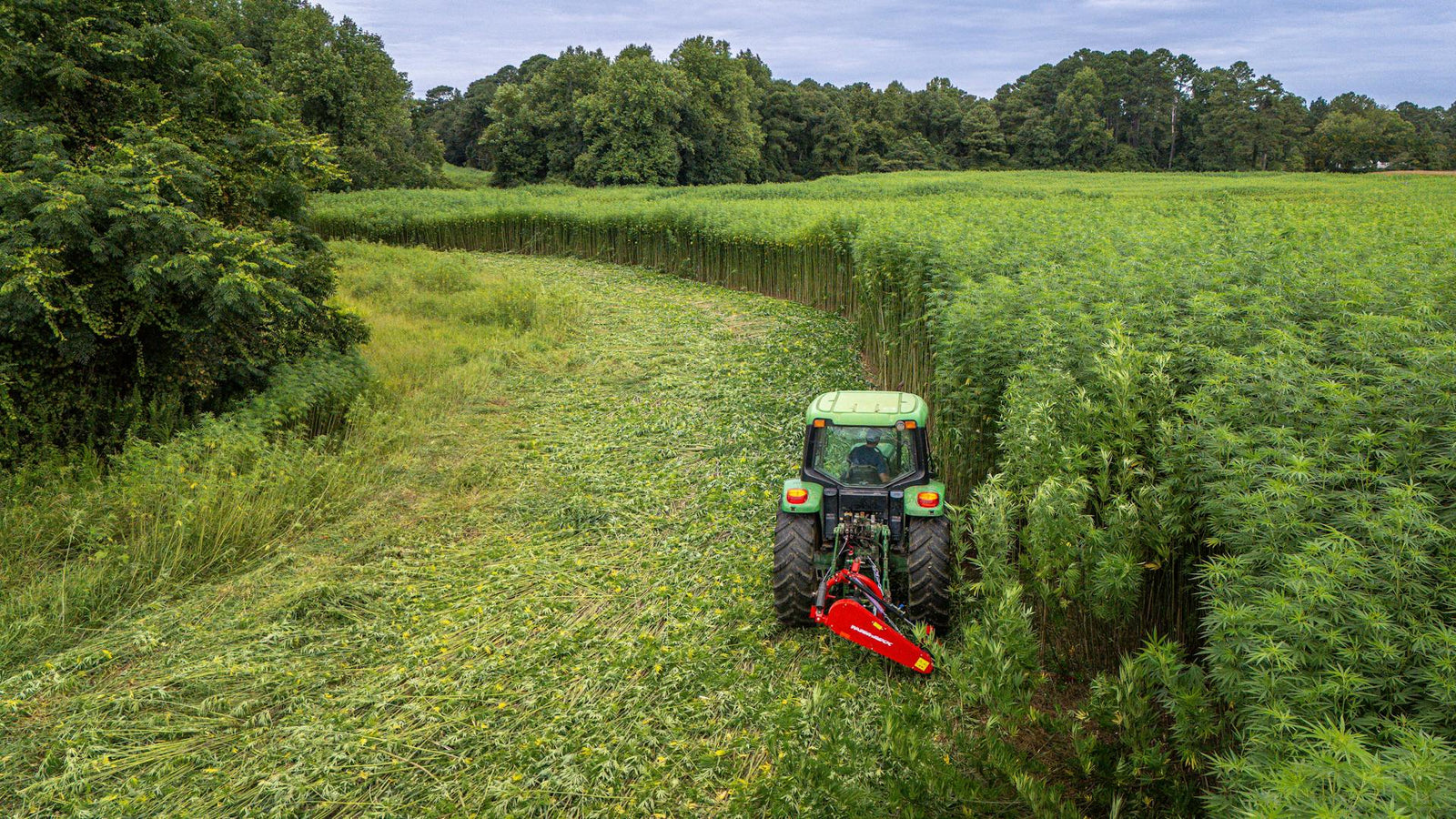
Hemp and CBD cultivation in France: who is allowed to cultivate, what varieties are authorized, and why it's forbidden for individuals in 2026
Reading time: ~9 min, Cloud Store CBD legal guide.
The question regularly comes up in our customer messages: "If I find authorized variety seeds, I can grow them in my garden, right?" The short answer is no. And the long answer is more interesting, because it explains why France has become the leading European hemp producer while prohibiting cultivation for individuals, even for plants that contain almost no THC.
The subject deserves precise treatment, because the penalties incurred are serious (up to 20 years of imprisonment for drug production, article 222-35 of the Penal Code) and because the line between declared agriculture and personal cultivation is clear in the texts. This guide reviews official sources: decree of December 30, 2021, Public Health Code, Council of State decision 2022, MILDECA position, InterChanvre statistics.
The objective is not to judge those who would want to plant at home. It is to explain the framework, authorized varieties, and why sourcing from a traceable actor remains the safe path.
Quick answer
• Hemp cultivation in France is reserved for active farmers within the meaning of the CAP, upon declaration and with certified seeds. Individuals cannot legally plant, even a variety with less than 0.3% THC.
• Only varieties listed in the European catalog of agricultural plants (Cannabis sativa L.) are authorized: Fedora 17, Futura 75, Santhica 27, Felina 32, Finola, etc. The THC threshold is set at 0.30%.
• France is the 1st European hemp producer in 2024: 23,600 hectares cultivated by 1,550 producers, representing approximately 38% of the Union's surface area (InterChanvre).
• Production without declaration or outside authorized varieties: possible classification as drug production, up to 20 years of imprisonment and €7,500,000 fine (article 222-35 of the Penal Code).
What is the legal framework for hemp cultivation in France in 2026?
The reference text is the decree of December 30, 2021, published in the Official Journal on December 31, 2021, and revised in May 2024. This decree is issued pursuant to article R.5132-86 of the Public Health Code which classifies cannabis and tetrahydrocannabinols as poisonous substances (narcotics).
The decree exceptionally authorizes the cultivation, import, export, and industrial and commercial use of hemp, under three cumulative conditions: variety listed in the catalog, certified seeds, and THC level not exceeding 0.30%.
On December 29, 2022, the Council of State partially annulled this decree (decision no. 444887): it invalidated the general ban on the sale of raw flowers and leaves, deeming CBD non-psychotropic and the "general and absolute" ban disproportionate. Cultivation, however, remains regulated. For details on consumer rules and commercialization, see our complete guide to legal CBD in France.
The 4 texts to know
1. Article R.5132-86 of the Public Health Code: classifies cannabis as a narcotic.
2. Decree of December 30, 2021: provides for the derogation for industrial hemp (authorized varieties, 0.30% THC, certified seeds).
3. Council of State Decision no. 444887 (December 29, 2022): annuls the ban on the sale of low-THC flowers and leaves.
4. Article 222-35 of the Penal Code: penalties for drug production in case of cultivation outside the legal framework.
Who is allowed to cultivate hemp in France?
The decree of December 30, 2021, reserves hemp cultivation for "active farmers" within the meaning of European and national regulations (Common Agricultural Policy). Concretely, this means a declared farmer, registered with the Mutualité Sociale Agricole, and who meets the CAP criteria. An individual cultivating in their garden does not fall into this category, even if they use an authorized variety.
The farmer must follow several steps:
- Purchase certified seeds from an approved supplier (seeds circulating online are generally not).
- Declare their cultivation to the Fédération Nationale des Producteurs de Chanvre (FNPC) or its interprofessional body InterChanvre.
- Keep the official seed label for 5 years, which serves as proof in case of inspection.
- Undergo THC content controls on growing flowers (random sample analysis).
The decree also prohibits the sale of plants and cuttings. This means that an end-buyer cannot legally obtain a ready-to-grow plant: only seeds are authorized, and only for declared agricultural use.
What hemp varieties are authorized in 2026?
Authorized varieties are those listed in the common European catalogue of agricultural species (Cannabis sativa L.). This database, managed by the European Commission, lists all varieties evaluated and approved in the Union. The technical protocols of the Community Plant Variety Office (CPVO) specify the genetic evaluation criteria.
On the historical French and European side, the best-known varieties include:
| Variety | Origin / type | Dominant profile |
|---|---|---|
| Fedora 17 | France (CCPSC) | Historic monoecious variety, versatile for fiber + seed |
| Futura 75 | France | Widely used in French agriculture, good fiber yields |
| Santhica 27 | France | Stable low THC, selected for cosmetics and food |
| Felina 32 | France | Fiber variety, adapted to northern European cultivation |
| USO 31 | Ukraine, authorized in EU | Fiber / seed variety, short cycle |
| Finola | Finland | Seed variety, very short cycle, adapted to northern latitudes |
Any variety outside the catalog or not certified falls into an illegal zone, regardless of the actual THC level of the plant. This is an important point: legality does not only depend on the result (measured level), but also on the genetic origin and the seeds used.
What exactly does the 0.30% THC threshold mean?
The European threshold of 0.30% has been raised from 0.20% by Regulation (EU) 2021/2115. It applies to the entire plant during growth, measured by laboratory analysis on the flowering tops. This is the control carried out by state services through random sampling during the season.
This threshold is not the same as the THC threshold in finished products sold to the consumer. The Council of State decision of December 29, 2022 confirmed that finished CBD products (oils, flowers, resins) must also comply with the 0.30% THC threshold, otherwise they fall into the narcotics category. To understand how to read a CBD product label and verify compliance, see our CBD oil buying guide.
Why this threshold and not another? Genetic selection today allows for the production of varieties where the CBD/THC ratio is very favorable (sometimes 20:1 to 50:1). The 0.30% allows a margin of tolerance for natural variations between plants, without allowing the appearance of measurable psychotropic effects. The CPVO protocols detail how varieties are selected based on this genetic criterion.
Can CBD be grown at home? The clear answer
No. Growing hemp or CBD at home is forbidden in France, even with an authorized variety and even if the plant respects the THC threshold. The legal reason: the decree of December 30, 2021, reserves cultivation for active farmers, and the official position of Drogues Info Service (Public Health France public service) is explicit: planting by an individual remains illegal.
⚠ Penalties incurred
Article 222-35 of the Penal Code punishes the illicit production or manufacture of narcotics with 20 years of criminal imprisonment and a €7,500,000 fine (30 years for organized gangs). In practice, for an individual who cultivates a few plants for personal use, the qualification can be reduced to use (article L.3421-1 of the Public Health Code: 1 year in prison and a €3,750 fine). But the penal risk exists, regardless of the number of plants.
The argument "I just wanted to try a 0.1% THC variety for well-being" does not hold up in court, because it is not the actual level that determines the legality of cultivation, but administrative authorization. Without an active farmer declaration, without certified seeds, cultivation is in violation.
The legal and safe alternative: go through a traceable French professional actor. This is the Cloud Store CBD model, and that of most serious brands on the market.
Why is France the leading European hemp producer?
France is not an insignificant country when it comes to hemp: it is the 1st European producer. According to InterChanvre (the interprofessional body recognized by the Ministry of Agriculture), the sector in 2024 had 23,600 hectares cultivated by 1,550 producers, representing approximately 38% of the European Union's surface area. Surface areas have tripled in ten years, rising from around 7,000 ha in 2013-2014 to over 23,000 ha today.
This growth is explained by the diversification of outlets: fiber (textile, building insulation, paper), seed (food, edible oil, cosmetics), and more recently flowers and leaves for the CBD market since 2022. The sector aims for 46,000 hectares by 2027 according to La France Agricole, a doubling.
To understand how some producers are pushing traceability even further with organic cultivation or aquaponics, see our dedicated article on organic hemp.
From cultivation to sold CBD flower: how does the chain work?
Understanding the chain helps to understand why a serious CBD product costs more than a questionable one. There are three links in France.
1. The agricultural producer. They cultivate their declared plot, with certified seeds, under administrative control. They deliver the raw material (flowers, leaves, fibers, seeds depending on the variety) to a processor or directly to a brand that subcontracts the processing.
2. The processor. They dry the flowers (curing), sort, grade, sometimes extract oil (supercritical CO2 most often), and carry out laboratory analyses (third-party COA: CBD level, THC compliance, pesticides, heavy metals, residual solvents).
3. The distributing brand. They package, label, and distribute. This is the visible link for the consumer. Its quality depends on the traceability of the two preceding links and the seriousness of its selections.
The ANSM alerted in June 2025 to hundreds of intoxications linked to products that presented themselves as CBD but actually contained undeclared synthetic cannabinoids (HHC, H4CBD, EDMB-4en-PINACA). These products generally come from opaque supply chains where one of the three links is not traceable. The reflex of the serious consumer: ask for the COA and check the origin.
Why Cloud Store CBD does not cultivate itself?
Cloud Store CBD is a distribution brand, not an agricultural producer. This precision is important because it clarifies our position in the chain: we do not plant, we do not process internally, we select traceable French partners, and we distribute.
This logic makes sense. Hemp cultivation requires land, equipment, agricultural skills, and registration with the CAP. Processing requires industrial equipment (drying, extraction, packaging). Wanting to do everything yourself often leads to average quality across all links. Specializing means doing better at what you master.
Concretely, we work with two French producers selected for the stability of their batches, the transparency of their analyses, and the aromatic quality of their selections. Our headquarters are in Charente. All our batches are accompanied by a verifiable third-party COA. We do not commercialize synthetic cannabinoids (HHC, H4CBD, THCP, "CBD+"), consistent with the approach of some of our clientele who are looking to move away from psychoactive products: see our guide on stopping THC.
In summary: what you need to remember
Hemp cultivation in France is strictly regulated but dynamic. France has become the leading European producer with 23,600 hectares cultivated by 1,550 producers in 2024. The conditions are clear: active farmer status, certified seeds, varieties listed in the European catalogue, plant THC level < 0.30%.
For individuals, the answer is unambiguous: domestic cultivation remains illegal, regardless of the variety or actual THC level. Penalties range from a fine to 20 years imprisonment, depending on the charge. The safe route is to purchase finished products from a traceable vendor.
To understand the full legal framework for commercialisation and consumption, see our complete guide on legal CBD in France in 2026.
Discover our French CBD flowers, resins, and oils, traceable and compliant, selected from two partner French producers.
View our CBD flowersFAQ — Hemp and CBD Cultivation in France
Is hemp cultivation legal in France?
Yes, but under strict conditions: only an active farmer registered with the CAP can cultivate hemp, using certified seeds of a variety listed in the European catalogue, with a plant THC level below 0.30%. The framework is set by the decree of 30 December 2021 and Article R.5132-86 of the Public Health Code.
Can I grow CBD at home in France?
No. Hemp cultivation is reserved for active farmers, and the official position of Drogues Info Service is unambiguous. Even with an authorised variety with less than 0.30% THC, an individual planting at home is subject to penalties ranging from a fine to 20 years imprisonment (Article 222-35 of the Penal Code), depending on the charge.
What is the authorized THC level in France?
The European threshold is set at 0.30% THC on the entire growing plant, as per Regulation (EU) 2021/2115. This same threshold applies to finished CBD products (flowers, oils, resins) marketed to consumers, in accordance with the decision of the Council of State of 29 December 2022.
Which hemp varieties are authorized in 2026?
Only varieties listed in the common European catalogue of agricultural species (Cannabis sativa L.) can be legally cultivated. The most well-known French and European varieties include Fedora 17, Futura 75, Santhica 27, Felina 32, USO 31, and Finola. The catalogue is regularly updated by the European Commission.
Why is France the leading European producer?
France cultivated 23,600 hectares in 2024 with 1,550 producers, representing about 38% of the European Union's acreage, according to InterChanvre. This position is explained by a mature regulatory framework, varieties selected by INRAE, and a diversity of outlets (fibre, seed, CBD flowers). The sector aims for 46,000 hectares by 2027.
What are the penalties for cultivating hemp without authorisation?
Article 222-35 of the Penal Code provides for up to 20 years of criminal imprisonment and a €7,500,000 fine for drug production. For an individual cultivating a few plants for personal use, the charge can be reduced to personal use (1 year imprisonment, €3,750 fine). The penal risk exists regardless of the THC level or the number of plants.
Useful sources
Légifrance — Decree of 30 December 2021 (hemp, THC < 0.30%) (accessed on 5 May 2026)
Légifrance — Article R.5132-86 of the Public Health Code (accessed on 5 May 2026)
Conseil d'État — Decision no. 444887 of 29 December 2022 (accessed on 5 May 2026)
Légifrance — Article 222-35 of the Penal Code (drug production) (accessed on 5 May 2026)
MILDECA — CBD, official page (accessed on 5 May 2026)
Drogues Info Service — Planting and law (accessed on 5 May 2026)
European Commission — Cannabis sativa L. varieties catalogue (accessed on 5 May 2026)
CPVO — Technical protocol Cannabis sativa (accessed on 5 May 2026)
InterChanvre — The hemp sector in France (accessed on 5 May 2026)
ANSM — Cannabinoids listed as narcotics (June 2025) (accessed on 5 May 2026)
⚠ Important note: This article is provided for informational purposes only. It does not replace personalised legal advice. Regulations may change; consult official texts (Légifrance, MILDECA) or a specialized lawyer for any specific questions. This article does not constitute an incitement to cultivate outside the legal framework.