Updated May 12, 2026, by Frédéric Penain (Cloud Store CBD). Sources: Légifrance, ANSM, FAO.
Quick Answer: Organic CBD and Aquaponics in France 2026
Since 2025, French authorities have prohibited certification bodies (Ecocert, Bureau Veritas) from issuing the AB label for CBD products. Any mention of "certified organic CBD" in 2026 is therefore non-compliant. Quality is now proven by documented cultivation methods and certificates of analysis, not by a label. Aquaponics guarantees, due to technical constraints (toxic to fish), zero pesticides, zero synthetic fertilizers, and -90% water consumption (FAO, 2014). Cloud Store is building its aquaponics greenhouse in Charente, aiming for 2027.
"Organic CBD" has been a marketing trap in France since 2025. Not because producers are dishonest, but because France has simply forbidden certification bodies (Ecocert, Bureau Veritas, AB label) from issuing the "organic" label for products containing CBD. This means that any bottle displaying "certified organic CBD" on its label in 2026 violates regulations. So how do you know if a production is truly clean? The answer lies in the cultivation method, not the label. This is where aquaponics comes in.
The Essentials in 30 Seconds
- The AB / Ecocert label is forbidden on CBD products in France since 2025.
- Therefore, no CBD product sold in France can legally display "certified organic."
- Aquaponics guarantees the absence of fertilizers and pesticides by technical design (fish would not tolerate them), not by certification.
- Four concrete promises of serious aquaponic production: zero pesticides, zero synthetic fertilizers, water savings, total traceability.
- Cloud Store is building its aquaponics project in Charente, aiming for 2027. In the meantime, we source from selected French partner producers based on their transparency.

1. The Paradox of Organic CBD in France 2026
The situation is paradoxical, and few shops explain it honestly. Since 2025, French authorities have prohibited official bodies like Ecocert or Bureau Veritas from issuing organic certification for any product containing CBD. Concretely, even a producer who cultivates their hemp according to strictly organic specifications (without pesticides, without chemical fertilizers, on living soil) can no longer use the term "organic" or display the AB label on their flower bottle or CBD oil.
The regulatory reason lies in the legal status of CBD: France places it in a particular area, governed by European regulation (EU) 2015/2283 on Novel Foods, and explicitly excludes CBD from the scope of the European organic label. Hemp cultivated for textile or industrial uses remains eligible, but as soon as we talk about CBD use, the label is dropped.
2. What This Actually Changes for You
Three practical consequences when you buy CBD in 2026.
- Any mention of "certified organic CBD AB" on a French site is illegal. If you come across it, it's a sign that you're being told unverified information.
- The absence of a label does not mean an absence of quality. A serious producer can very well cultivate without pesticides or chemical fertilizers without being able to display it as "organic." Quality shifts to other proofs: certificates of analysis, documented cultivation methods, transparency about origin.
- Vague mentions like "organic," "natural," "ecological" without technical precision have become a marketing playground. Without an official framework, anyone can write what they want. Ask for the exact cultivation method; it's the only reliable answer.
To understand the complete legal framework for CBD in France: CBD legal in France in 2026: what the law says.
3. Why Aquaponics Goes Further Than Classic Organic
Aquaponics does not rely on a label. By its very design, it is stricter than organic specifications. In organic soil cultivation, one commits to not using pesticides or synthetic fertilizers, and an annual audit verifies this. This is trust in a contractual promise. In aquaponics, it's different: you cannot use them, even if you wanted to. The fish would die in a few hours, as would the bacteria that run the system.
This is what is called a "by design" guarantee rather than "by certification." Three practical differences from classic organic:
- No possible deviation: an organic soil producer may, in case of stress (disease, pests), be tempted to violate rules. An aquaponics producer, on the other hand, does not have this option. The system physically prohibits it.
- No accumulated residues in the soil: French agricultural soils carry decades of inputs. In aquaponics, the substrate is neutral (clay balls, coconut fiber). No chemical legacy.
- Radical water savings: -90% compared to conventional agriculture (FAO, 2014). Classic organic does not reduce water consumption; it uses it differently. Aquaponics divides it by ten.
The Aquaponics Cycle in Practice
Aquaponics relies on a three-tiered living cycle: fish (usually tilapia or trout in temperate climates) produce waste rich in ammonia; nitrifying bacteria (Nitrosomonas, Nitrobacter) convert this ammonia into nitrites then nitrates; hemp plants absorb these nitrates as a nitrogen source, and their filtering action returns clean water to the fish tank. The system runs in a closed loop.
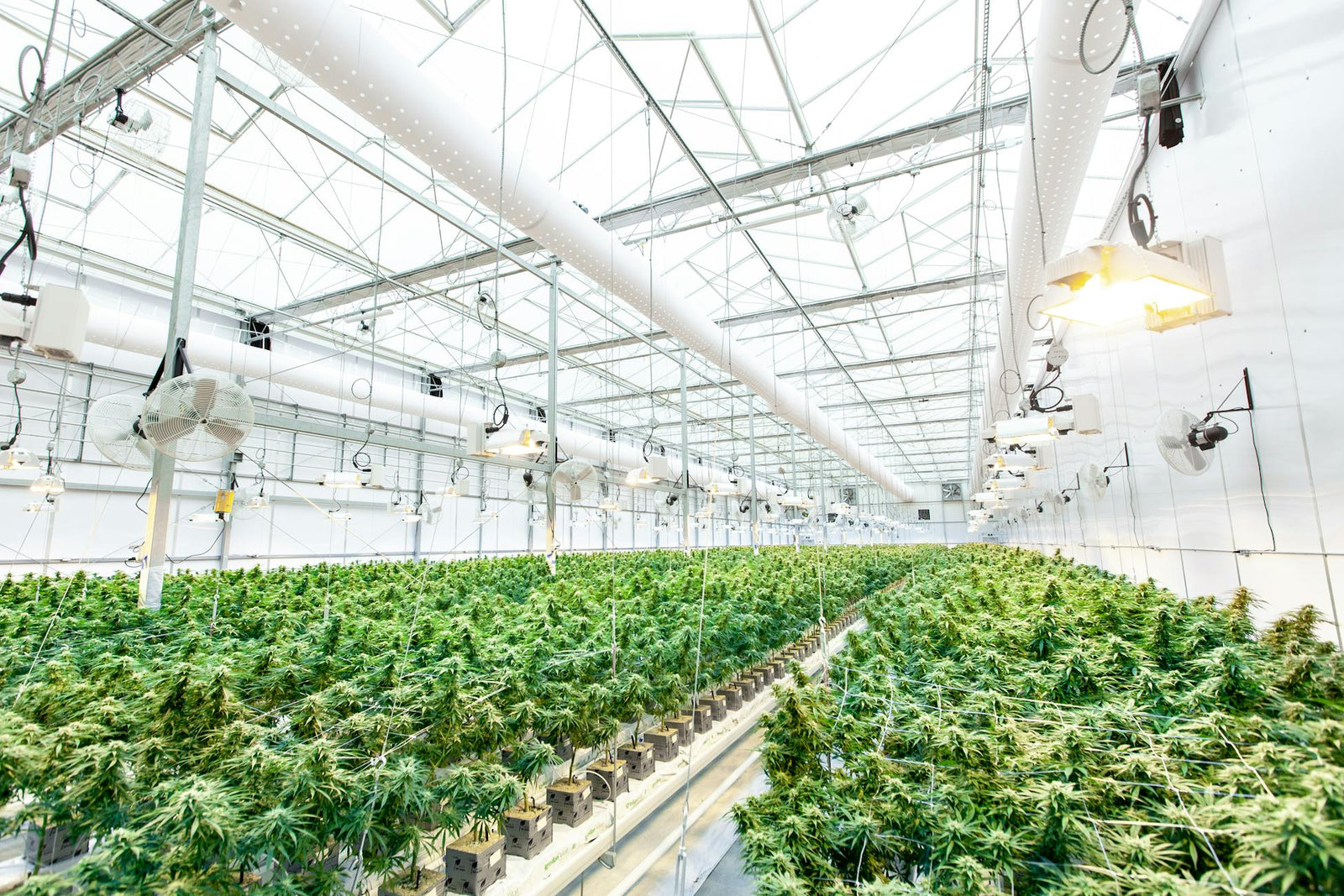
Concretely, an aquaponics greenhouse for CBD integrates four elements:
- Fish tank: reasoned density (15-20 kg/m³ for balanced production), temperature 18-22 °C depending on the species.
- Biological filter: area colonized by nitrifying bacteria. This is the heart of the system.
- Grow bed: expanded clay balls or coconut fiber, chemically neutral. This is where the plant roots develop.
- Regulation: pumps, pH probes, temperature, oxygen, conductivity. Everything is continuously monitored.
Observed yields in well-dimensioned CBD aquaponics are superior to conventional soil cultivation: up to 10× the productivity per m² for certain varieties, according to the APIVA program of INRAE. At the cost of a higher initial investment and specialized technical expertise: an uncontrolled aquaponics system quickly collapses (the death of a single batch of fish interrupts the entire nutrient cycle).
4. The 4 Concrete Promises of Serious Aquaponics Production
Well-executed CBD aquaponics production makes four measurable promises. This is what we aim for with our own project in Charente.
- Zero synthetic pesticides. Not by commitment, but by technical constraint: the nitrifying bacteria in the system do not survive the slightest synthetic molecule.
- Zero chemical fertilizers. Plant nutrition comes exclusively from fish waste, transformed by bacteria into assimilable nitrates. The nitrogen balance is 100% organic.
- Water saved. -90% compared to an equivalent soil cultivation. Water does not leave the circuit; it only replenishes to compensate for plant evapotranspiration.
- Total traceability. Every parameter is measured and logged: fish feed, temperatures, pH, cannabinoid profile of each harvest. No batch is anonymous.
None of these promises require a label to be verifiable. They are proven by figures and analyses.
5. The Cloud Store Project: Where We Are Today
Let's be clear: we are not yet selling our own aquaponically grown harvest. The online store launched at the end of 2025, and our aquaponics greenhouse is under construction on family land in Charente. Target date: 2027. In the meantime, we source from two French partner producers, selected based on three criteria:
- Total transparency on hemp variety, origin, and cultivation method.
- Up-to-date Certificate of Analysis (COA), from an independent laboratory, for each batch.
- Verifiable commitment against synthetic cannabinoids (HHC, H4-CBD, THCP, etc.): molecules classified as narcotics by the ANSM in June 2024, which we categorically refuse.
We prefer to explain this transitional scheme to you rather than displaying an "aquaponics" label that would be false today. When our harvest is ready, it will be explicitly stated on each product page, with the corresponding batch number and analysis. No tight schedule announced: we switch when quality is assured.
Geographically, the head office is in Angoulême. The cultivation site, on family land, is in Charente. The exact commune remains discreet for security reasons, as is customary in the industry. The Nouvelle-Aquitaine region is one of the historic areas for French hemp, which helps for local varieties and agricultural know-how.
6. How to Verify if CBD is Truly Clean When the Label No Longer Exists
Without an AB label, how do you avoid being deceived? Five questions to ask the seller before purchasing.
- What is the cultivation method? Outdoor soil, indoor, hydroponics, aquaponics, greenhouse. If the seller doesn't know, it means they are buying anonymous batches.
- What is the origin and variety? France, Switzerland, Italy + precise variety (Felina 32, Futura 75, Kompolti…). A vague answer = red flag.
- Is the COA downloadable? The certificate of analysis must list the complete cannabinoid profile, measured THC, and ideally terpenes and pesticide screening. Dated less than 12 months.
- What is their stance on synthetic cannabinoids? A serious seller offers neither HHC, HHCO, HHCP, H4-CBD, nor THCP. All classified as narcotics by the ANSM in 2024.
- What is the price per gram? Below €1/g for flower, be suspicious: this rarely corresponds to a clean French production cost. Conversely, a price above €8/g for a common variety is often premium marketing without real value.
To learn more about product selection: How to choose your CBD flower.
Our current selection comes from French partner producers, pending our own aquaponics harvest in Charente.
See our CBD flowersFAQ: Organic CBD and Aquaponics
Does organic CBD really exist in France?
Officially no, since 2025. French authorities have prohibited certification bodies like Ecocert or Bureau Veritas from issuing the AB label for products containing CBD. Any mention of "certified organic CBD" in 2026 on a French website is therefore non-compliant. Quality is proven through other means: documented cultivation methods, certificates of analysis, traceability.
Why is the organic label prohibited for CBD?
France classifies CBD in a particular regulatory zone, governed by European regulation (EU) 2015/2283 on Novel Foods. This classification excludes CBD from the scope of the European organic label. Hemp intended for textile or industrial uses remains eligible, but CBD does not.
Does aquaponics replace an organic label?
Aquaponics does not qualify for an official label for CBD in France. However, it technically guarantees the absence of synthetic fertilizers and pesticides, due to the physical constraints of the system (toxic to fish and bacteria). It is a "by design" guarantee that is stricter than classic organic specifications.
What are the measurable benefits of aquaponics?
Four measured benefits: -90% water consumption compared to soil cultivation (FAO 2014), zero chemical inputs possible (the system is toxic to fish if added), productivity per m² up to 10× higher according to the APIVA program of INRAE, and total traceability of cultivation parameters (pH, temperature, feeding, cannabinoid profile of the batch).
Does Cloud Store CBD already sell aquaponic CBD?
Not yet. Our aquaponics greenhouse is under construction in Charente, targeting 2027. Today, we source from two French partner producers, selected for their transparency and certificates of analysis. The transition to our own harvest will be gradual, with explicit mention on each product page.
How can I be sure that CBD has not been grown with pesticides?
Ask for the Certificate of Analysis (COA) for the exact batch. A serious COA includes a residual pesticide screening in addition to the cannabinoid profile. In aquaponics, the question doesn't even arise: any pesticide would kill the system. But in soil cultivation, only laboratory analysis proves absence.
General information updated in the first half of 2026. Regulations may change. Sources: Légifrance, ANSM, FAO, INRAE APIVA program.